
About the Book
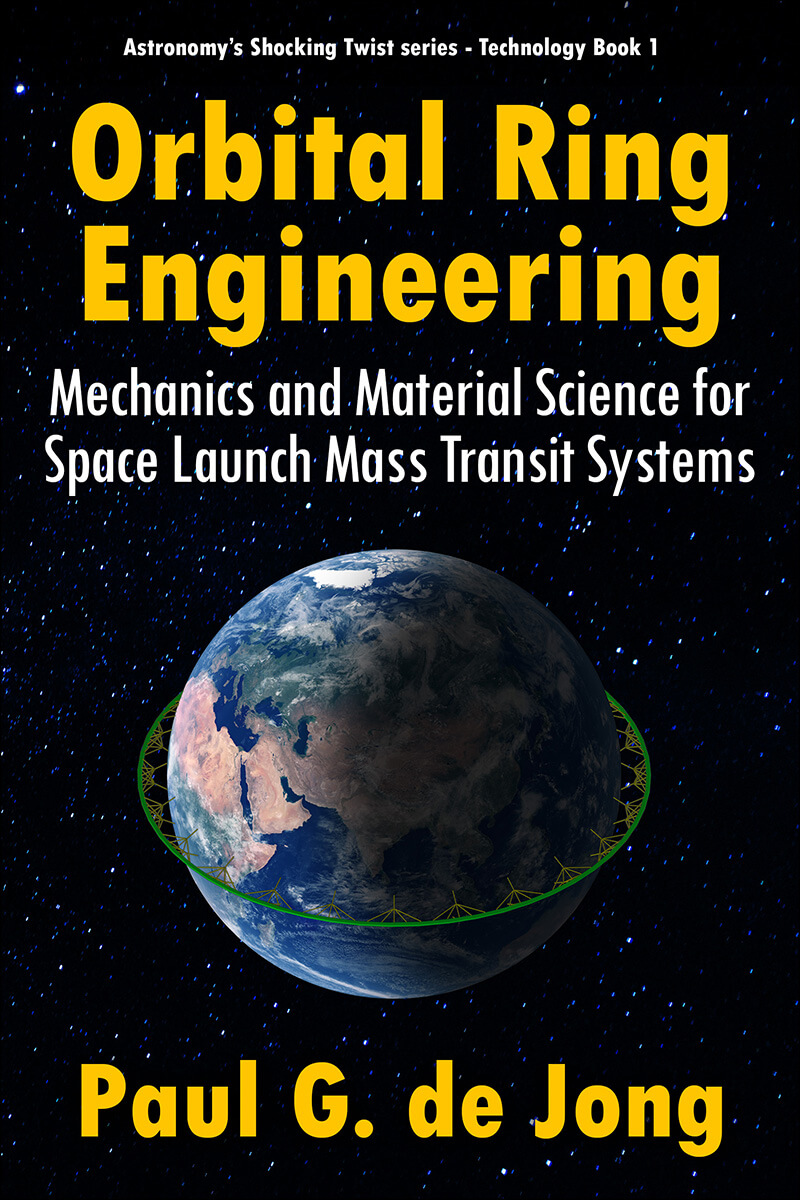
Orbital Ring Engineering is a deep dive into the physics, material science, and engineering required to construct an orbital ring.
It presents a set of assumptions and guides the reader through a discovery process, delving deeply into the various materials, physics, electrical engineering, orbital mechanics, and mathematics involved in this endeavor.
The book invites readers to think about the challenges and contribute to the innovations. What are the optimal numbers? Are my assumptions correct?
This website presents the design concepts highlighted in the book, as well as some findings. To explore the math, assumptions presented in the book Orbital Ring Engineering, keep exploring this website.
The seeds for this book series were planted more than ten years ago. Over the years, I have played with many of these ideas, working out details in my journals. The stories skirt the line between fiction and non-fiction and have been largely inspired by Isaac Arthur’s YouTube channel: @isaacarthurSFIA, “Science & Futurism with Isaac Arthur”
The genre is hard science fiction. My definition of hard science fiction is that all the laws of physics are obeyed as they are currently understood. I apply a relatively strict definition, limiting the text to technologies and materials that are either currently available or can reasonably be expected to become available in the near future. I also strive to keep the engineering within reasonably speculative bounds; however, the term “reasonable” is relative.
Reasonable becomes much more extreme when the motivation is extreme. Even if the economics present an extreme challenge, when the entire human race is at stake, the economics no longer really matter; what matters are the results. As the science fiction books will reveal, the motivation is indeed present, and humanity will do what it has to in order to make what needs to be done happen. Nothing else matters.
As the science fiction books will reveal, the motivation is indeed present, and humanity will do what it has to in order to make what needs to be done happen. Nothing else matters.

About the author

Paul de Jong is a speculative science and hard science fiction author, a lifelong inventor, explorer, and student, and a serial entrepreneur with a deep love for physics. Over the years, he has examined many perspectives of space travel and infrastructure, working out the details in his journals.
You can find him on a few selected social networks.
instagramfacebookpatreongithubamazonlinkedin

Get your Hard Cover Book Now
Hard coVER book available!
JOIN the newsletter.
Sign up to our newsletter for updates.
Follow the Project on
patreongithubinstagramfacebooktiktokamazon