Perovskites and Type II Superconductors
Introduction What is a Perovskite? Why Perovskites Matter Perovskites in Superconductors? Connecting Back to Orbital Ring Engineering References
Perovskite Locality: Magnet Cove, Hot Spring County, Arkansas, USA. Ex. American Museum of Natural History, Clarence Bement collection, donated in 1910. Rob Lavinsky, iRocks.com – CC-BY-SA-3.0, CC BY-SA 3.0, via Wikimedia Commons
This post is the abstract of a long-form article I shared to my supporters on Patreon. If you are interested in the full content, please consider supporting me on Patreon.
Introduction
The term perovskite has been coming up in a lot of scientific papers lately--especially in contexts like high-efficiency solar cells, coloured LEDs and fluorescent dyes. It also appears in the context of high-temperature superconductors.
So what exactly is a perovskite? And how does it tie to type II superconductors and to Orbital Ring Engineering? Let’s explore these links.
What is a Perovskite?
The name "perovskite" originally described the mineral perovskite, but now refers to any material with the same crystal structure, which is typically a cubic lattice. At its simplest, a perovskite refers to a material with the same crystal structure as the mineral calcium titanium oxide (CaTiO₃). In more general scientific usage, the term is applied to materials that adopt the so-called “perovskite structure” with a general chemical formula ABX₃. In that formula (Zhai et al. 1):
- The “A” site is typically a relatively large cation (often alkaline-earth, rare-earth, or organic in hybrid materials).
- The “B” site is a smaller cation (often a transition metal).
- The “X” site is an anion (commonly O²⁻ in oxide perovskites, or halides in halide perovskites).
Many perovskites are ceramic materials - hard, brittle, and built from repeating layers of atoms. In their ideal form, each small “B-site” atom sits at the center of an octahedron made of six surrounding “X” atoms, while the larger “A-site” atom fits into the spaces between these octahedra. The mineral CaTiO₃ has a slightly distorted version of this cubic pattern, and it’s the structure that gives the whole family of perovskites its name.
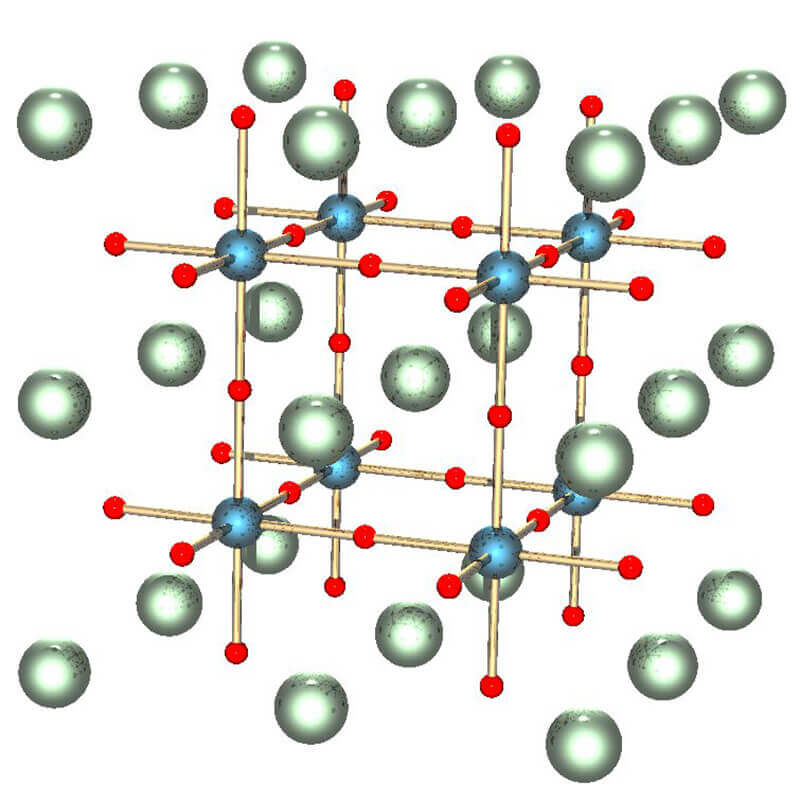
Cadmium at English Wikipedia, Public domain, via Wikimedia Commons
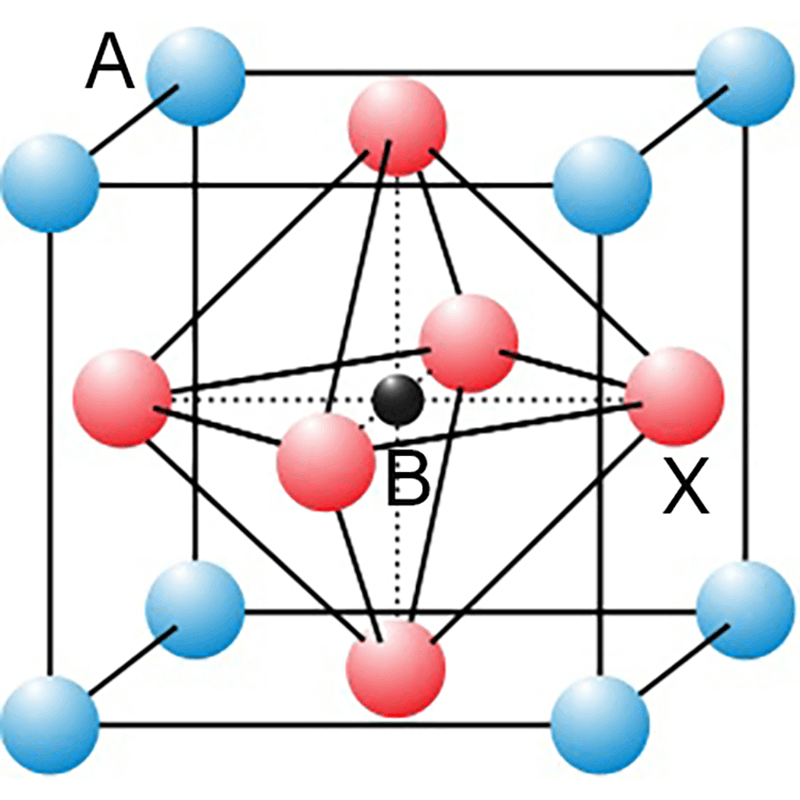
File licensed under the Creative Commons Attribution-Share Alike 3.0 Unported license.
The left image shows the layered structure that is typical of a perovskite. The right image shows the typical box structure. The corner atoms in the right image are shared with the adjacent box structure in the perovskite lattice, as depicted in the left image. The box structure is a simple representation of the structure, but as we shall see later, the pattern can be far more complex, incorporating different atoms in a multilayered structure.
Because of the flexibility of the lattice (i.e., substitution at A, B, and X sites; distortions/tilts of the octahedra; layered variants), the perovskite family is tremendously versatile: one finds ferroelectrics, multiferroics, piezoelectrics, catalysis materials, photovoltaics, LED materials, and superconductors among them.
Perovskite-type structures occur not only in the simple cubic ABX₃ form, but also in layered variants such as double perovskites, triple perovskites, and halide perovskites such as methylammonium lead iodide (CH₃NH₃PbI₃) which is shown below. Methylammonium lead iodide has one of the highest solar conversion efficiencies found to date (Eames et al. 2). The flexibility of the perovskite structure is part of the reason for their enormous research appeal.
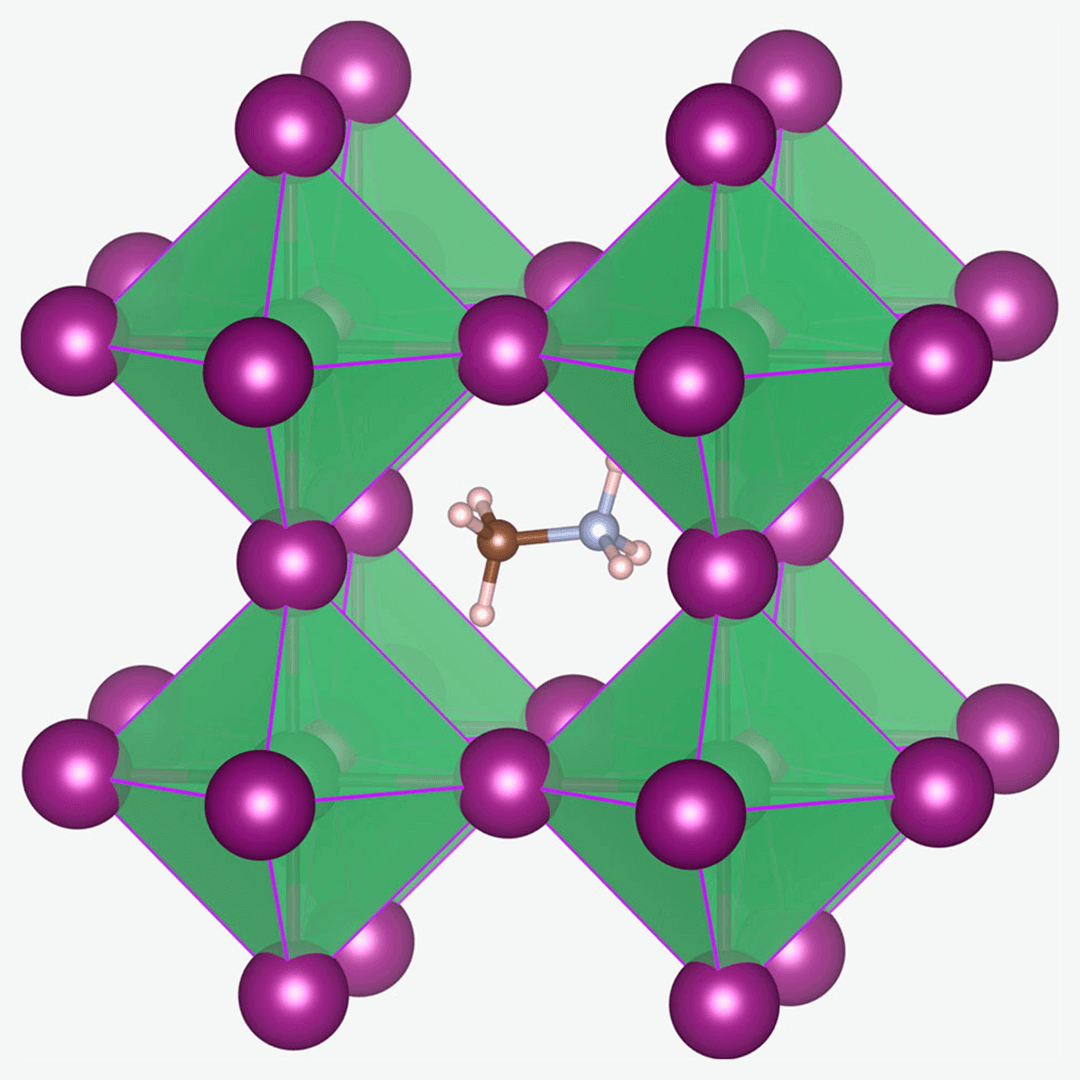
Crystal structure of methylammonium lead iodide CH3NH3PbX3 perovskites (X=I, Br and/or Cl). The methylammonium cation (CH3NH3+) is surrounded by PbX6 octahedra. Christopher Eames et al., CC BY 4.0, via Wikimedia (Eames et al. 2)
Why Perovskites Matter
Because of their flexible crystal structure, perovskites can be “tuned” to behave in many different ways. Scientists can change their electrical, optical, or magnetic properties by adjusting which atoms occupy the A, B, or X sites, by adding impurities (a process called doping), or by slightly distorting the lattice through thin-film growth or layered stacking.
This tunability makes perovskites useful in a surprisingly wide range of technologies:
-
Photovoltaics (solar cells) - Perovskites can absorb sunlight very efficiently. They have adjustable bandgaps, long charge-carrier lifetimes, and can be processed from inexpensive solutions, making them a leading candidate for next-generation solar panels (Perovskite Solar Cells 3).
-
Ferroelectrics - These are materials that maintain a built-in electric polarization that can be reversed by applying an external voltage, making them useful for non-volatile memory chips and sensors. Perovskites such as barium titanate (BaTiO₃) are classic examples (Lee 4).
-
Piezoelectrics - These materials convert mechanical stress into electrical voltage (and vice versa). Perovskite ceramics like lead zirconate titanate (PZT) are widely used in microphones, ultrasound transducers, and precision actuators. (Uchino 5)
-
Supercapacitors and batteries - Some perovskite oxides can store and release charge rapidly thanks to their high surface area and fast ion mobility, making them potential materials for energy storage and fast-charging devices. (Zhang 6)
-
Catalysis and energy conversion - Oxide perovskites can act as electrodes or catalysts in fuel cells and water-splitting systems. Their ability to exchange oxygen ions and conduct both ions and electrons makes them efficient for chemical energy conversion (Tenzin et al. 7).
In short, the perovskite structure is a kind of designable atomic framework - a versatile lattice where scientists can swap atoms and alter geometry to tailor almost any combination of electrical, magnetic, optical, or chemical properties.
Perovskites in Superconductors?
One of the most remarkable things about perovskites is that the same crystal structure used in solar cells also shows up in high-temperature superconductors.
A superconductor is a material that can carry electrical current with zero resistance when cooled below a certain critical temperature. It also expels magnetic fields - an effect called the Meissner effect. Traditional, or type I, superconductors lose this property as soon as the magnetic field gets too strong.
But type II superconductors behave differently: they let magnetic flux enter in tiny, thread-like vortices while the rest of the material stays superconducting. This allows them to operate under much stronger magnetic fields, which is why they are used in powerful magnets and particle accelerators.
The so-called high-temperature superconductors (HTS) - discovered in the 1980s - are all type II. Many of them, such as yttrium barium copper oxide (YBa₂Cu₃O₇) and bismuth strontium calcium copper oxide (Bi₂Sr₂Ca₂Cu₃O₁₀), are built from perovskite-like layers.
These materials are ceramics composed of copper and oxygen sheets separated by layers containing other metals. Within those copper-oxide planes, electrons pair up and flow without resistance.
Because the perovskite lattice can easily be distorted or “doped” by adding different atoms, scientists can fine-tune its properties - changing how charge moves, how magnetic fields interact, and how strong the superconducting current can be.
This structural flexibility is exactly what makes perovskites so valuable, not just for solar cells, but for any technology that depends on controlling how electrons behave.
Even today, researchers are still exploring new perovskite variations, including hydrogen-rich compounds that might superconduct at much higher temperatures, perhaps one day even at room temperature.
If that happens, the same basic crystal framework that powers efficient solarcells could also revolutionize how we transmit and store electrical energy.
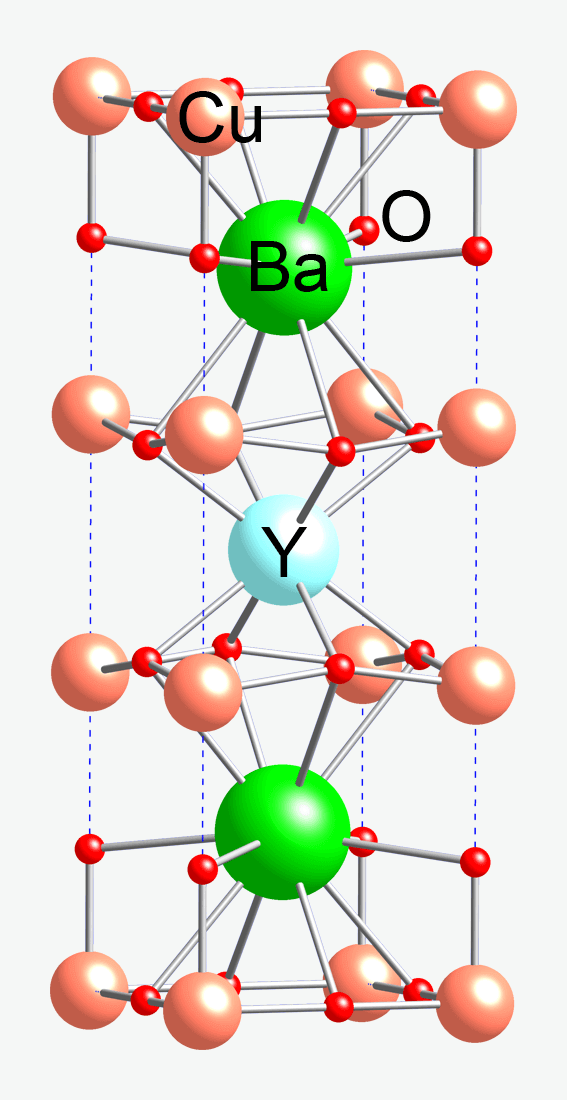
Unit cell of YBCO. Benjah-bmm27, Public domain, via Wikimedia Commons
Connecting Back to Orbital Ring Engineering
The reason perovskites and type II superconductors matter to orbital-ring concepts goes beyond academic curiosity. In Orbital Ring Engineering, materials like these become essential building blocks for the future of large-scale space infrastructure.
Perovskite-based coatings and thin films, for instance, could serve as high-efficiency solar absorbers on the outer hulls of orbital structures, converting sunlight directly into electrical power with minimal weight. Meanwhile, type II superconductors, especially those based on perovskite ceramics such as GdBa₂Cu₃O₇, are ideal candidates for magnetic-levitation tracks, power-distribution loops, and current-carrying cables that can operate at cryogenic temperatures in space.
Their ability to carry immense currents without resistance and to maintain magnetic fields makes them a cornerstone for concepts like flux-pinned levitation and electrodynamic stabilization, both central to the functioning of a practical orbital ring.
In other words, the same family of materials driving today’s breakthroughs in solar panels and electronics may one day form the electromagnetic skeleton of orbital infrastructure - powering mass drivers, stabilizing station rings, and enabling long-term, sustainable construction in orbit.
That’s the deeper connection: the chemistry of perovskites and the physics of superconductivity are not just laboratory curiosities, they’re the foundation stones for the next stage of human engineering in space.
References
-
Zhai, X., Ding, F., Zhao, Z. et al. Predicting the formation of fractionally doped perovskite oxides by a function-confined machine learning method. Commun Mater 3, 42 (2022). https://doi.org/10.1038/s43246-022-00269-9
-
Eames, C., Frost, J. M., Barnes, P. R. F., O’Regan, B. C., Walsh, A., & Islam, M. S. (2015). Ionic transport in hybrid lead iodide perovskite solar cells. Nature Communications, 6(1). https://doi.org/10.1038/ncomms8497
-
Perovskite Solar Cells: An In-Depth Guide + Comparisons with other techs. (2022, September 1). Solar Magazine. https://solarmagazine.com/solar-panels/perovskite-solar-cells/
-
Lee, T. U. 1950. “Ferroelectricity, Domain Structure, and Phase Transitions of Barium Titanate.” Reviews of Modern Physics 22 (3): 221–277. https://doi.org/10.1103/RevModPhys.22.221.
5.Uchino, Kenji. 2015. “Glory of Piezoelectric Perovskites.” Materials Today 18 (5): 251–258. https://doi.org/10.1016/j.mattod.2015.02.001.
-
Zhang, Q., Zhao, H., and Wang, X. 2021. “Recent Advances in Perovskite Oxides as Electrode Materials for Supercapacitors.” Chemical Communications 57 (60): 7434–7451. https://doi.org/10.1039/D1CC02667D
-
Tenzin Dawa, Baharak Sajjadi, “Exploring the potential of perovskite structures for chemical looping technology: A state-of-the-art review, Fuel Processing Technology”, Volume 253, (2024), 108022, ISSN 0378-3820, https://doi.org/10.1016/j.fuproc.2023.108022.
JOIN the newsletter
Sign up to our newsletter for updates. We respect your privacy.

Get your book copy Now
Book available in hard cover, PAPERBACK + Kindle versions!