Chapter One: What's Out There
An excerpt from The Orbital Ring, Volume I: The Economic Case for Space Mass Transit.
Introduction
The solar system is not empty. It is full of water, metals, energy, and destinations that could sustain a civilization far larger than the one we have now. The Moon has billions of tons of water ice sitting in permanently shadowed craters at its poles. Mars has a surface area roughly equal to all the dry land on Earth, with enough water ice to fill lakes. Venus, despite its hostile surface, has a habitable zone in its upper atmosphere with more usable three-dimensional volume than Earth's entire surface, and a nitrogen reservoir the rest of the inner solar system lacks. Asteroids contain metals and volatiles in quantities that dwarf anything we have mined in all of human history. The moons of Jupiter and Saturn harbor subsurface oceans that may be the most promising places to look for life beyond Earth, and several of these oceans are estimated to contain more water than all of Earth's oceans combined.
None of this is speculative. Every claim in the previous paragraph is backed by direct observation, sample return missions, or radar measurements. The data are in hand.
What we lack is the infrastructure to do anything about it. Getting to these places, and getting back, with the kind of regularity and volume that would make a real difference, requires a transportation system that does not yet exist. Rockets alone cannot do it. They are too expensive per kilogram, too limited in payload, and too dependent on propellant that must be carried from Earth. What is needed is a mass transit system to space, something that can move millions of people and thousands of tons of cargo per day, at velocities high enough to reach Mars in weeks rather than months, and that can sustain this pace indefinitely.
That system is an orbital ring, and this book will make the case for building it.
An orbital ring is a continuous structure that encircles the Earth in space. Inside it, a cable made from carbon nanotube yarn spins faster than orbital velocity. The excess centrifugal force of that spinning cable pushes outward against a stationary outer shell, and that outward push is what holds the entire structure up. This is called active support: the structure floats on the kinetic energy of the moving cable rather than standing on columns or hanging from a tower. The cable itself must withstand enormous tensile loads, but the principle that keeps the ring in the sky is dynamic, not static.
The outer shell is stationary relative to the ground. Because it is stationary, you can hang cables straight down from it to the surface, and those cables become elevators. You can mount mass drivers on the ring that launch cargo and passengers at velocities up to 30 km/s. Millions of people a day can use it for near-Earth destinations. Trips to Mars and Venus can be shortened to weeks. Cargo can be sent on fast trajectories to resupply missions anywhere in the solar system. All launches still require a propulsion system of some kind, even if it is only to maneuver into a docking station, but the mass driver provides the bulk of the velocity. You can hang solar arrays below the ring that generate several times the world's total electricity demand. The ring is both a transportation system and a power station.
The concept is not new. Nikola Tesla described something like it in the 1870s. The modern engineering treatment was published by Paul Birch in the Journal of the British Interplanetary Society in 1982-1983. The physics is straightforward. The materials exist or are near-term. The engineering is hard, but it is not speculative.
This book follows a logical progression that puts the orbital ring at the end rather than the beginning. The detailed discussion starts in Chapter 15 with alternative launch systems and continues in Chapter 16 with the orbital ring itself. This is not a novel, so there are no spoilers. If you want to start there, start there.
However, before examining the mechanics of how we leave Earth, we must understand why the destination justifies the immense effort. This chapter surveys the solar system as a destination and as a resource, starting close to home and working outward.
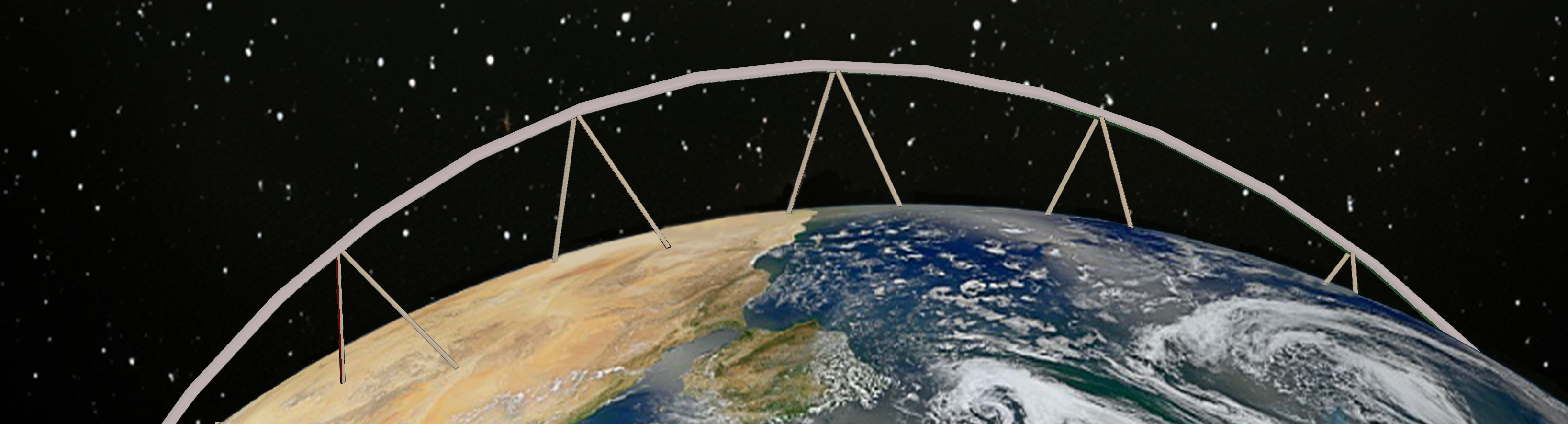 Image 1.1: The orbital ring encircling Earth. The ring sits at an altitude between 250 km and 2,000 km, following a great-circle trajectory. Mass drivers mounted on the ring can launch cargo and passengers to destinations throughout the solar system. This book makes the case for building it, starting with the destinations that justify the effort.
The Moon
The Moon is 384,400 km away, which is close enough that a radio signal makes the round trip in about 2.5 seconds. Apollo astronauts reached it in about three days using 1960s technology. It is, by far, the most accessible destination beyond Earth, and it turns out to be far more interesting than the lifeless rock people assumed it was after the Apollo program ended.
Water Ice at the Poles
The Moon's axis of rotation is tilted only 1.5 degrees relative to the ecliptic plane. This means that deep craters near the poles contain regions that have not seen sunlight in billions of years. These permanently shadowed regions, or PSRs, act as cold traps where temperatures can drop below 40 K (about -233°C). At these temperatures, water molecules that wander in from comet impacts, solar wind interactions, or micrometeorite deliveries get stuck. They accumulate over geological time.
NASA's LCROSS mission confirmed this in 2009 when it deliberately crashed a spent rocket stage into Cabeus crater near the south pole and measured the resulting debris plume. The impact revealed a water concentration of 5.6 ± 2.9% by mass in the regolith [1]. India's Chandrayaan-1 mission, using the Moon Mineralogy Mapper (M³) instrument, detected surface ice concentrations ranging from 2% to 30% by weight at latitudes above 70°, with an estimated 600 million cubic meters of water ice in the detected features alone [2].
Combined estimates for both poles suggest the Moon may hold up to 6 billion metric tons of water ice, split roughly evenly between north and south [3]. To put that in perspective, 6 billion metric tons is about 6 cubic kilometers of ice. That is a modest amount compared to Earth's ice sheets, but it is an enormous amount for the purpose of supporting a lunar base or manufacturing rocket propellant. Water can be split into hydrogen and oxygen by electrolysis, giving you both breathing air and the two components of a high-performance rocket propellant.
There is an important caveat. Most of this ice is not sitting in neat deposits waiting to be scooped up. Only about 3.5% of cold trap areas show exposed ice on the surface. The rest is intermixed with regolith as small chunks, thin films on grain surfaces, or chemically bound in minerals [3]. Extracting it will require heating the regolith and collecting the released water vapor, which is a well-understood process but one that requires energy and equipment.
Shackleton Crater
Shackleton Crater, located almost exactly at the lunar south pole, is one of the leading candidates for a future base site. It is 21 km in diameter and 4.2 km deep. Its rim receives nearly continuous sunlight, which means solar panels placed there would have power almost all the time. Meanwhile, the crater floor is in permanent shadow, potentially harboring water ice. This combination of persistent solar energy on the rim and cold-trapped volatiles in the interior makes Shackleton uniquely attractive.
The evidence for ice at Shackleton is mixed. Orbital measurements from MIT suggest water ice abundance of 2-3% by weight on sunlit inner walls, but high-resolution albedo measurements have not found large exposed ice deposits on the crater floor [4]. The ice may be disseminated through the soil at concentrations too low to detect from orbit. China's Chang'e-7 mission, scheduled for 2026, will carry a hopper spacecraft with a water molecule analyzer designed to probe directly inside permanently shadowed craters. India's Chandrayaan-3 mission in 2023 already detected sulfur, aluminum, calcium, chromium, iron, manganese, oxygen, titanium, and silicon in south pole soil, and its thermal measurements suggest that slopes steeper than 14 degrees in the poleward direction may accumulate ice at shallow depths [5]. NASA's PRIME-1 ice-mining experiment, launched in early 2025, is designed to directly test whether water ice is present in usable quantities. Within the decade, these combined missions will likely settle the debate over Shackleton's true resource potential.
Other Lunar Resources
Water is the headline resource, but the Moon's regolith is rich in other useful materials, and understanding what is available and what is not is critical for planning any sustained presence.
What the Moon Has in Abundance
The bulk composition of lunar regolith is dominated by six elements: oxygen (41-45% by weight, bound in oxides), silicon (~20%), iron (~13%), aluminum (6-18%, varying by region), calcium (~8%), and magnesium (~5%) [6]. Titanium concentrations in mare basalts can be ten times higher than typical Earth rocks. All of these are useful for construction, manufacturing, and life support.
Oxygen deserves special emphasis. It is the single most abundant element in the lunar regolith by weight. Nearly half of every scoop of lunar soil is oxygen, locked up in metal oxides like ilmenite (FeTiO₃), anorthite (CaAl₂Si₂O₈), and olivine ((Mg,Fe)₂SiO₄). Extracting that oxygen requires energy, not rare chemistry. Processes like molten regolith electrolysis or hydrogen reduction of ilmenite can liberate oxygen from these minerals, producing metal byproducts in the process. The oxygen becomes breathing air and rocket oxidizer. The metals become structural materials. A single processing chain gives you both.
Iron, aluminum, titanium, and silicon are all available in industrial quantities. Iron and titanium from ilmenite reduction, aluminum from anorthite, and silicon from silicate minerals can be used for construction, wiring, solar cells, and other infrastructure. Chandrayaan-3's Pragyan rover detected sulfur, chromium, and manganese in south pole soil in addition to the expected elements [5], expanding the known palette of locally available materials.
What the Moon Lacks: The Hydrogen and Nitrogen Problem
To sustain life and industry, you need six elements: carbon, hydrogen, nitrogen, oxygen, phosphorus, and sulfur, collectively known as CHNOPS. These are the building blocks of biology and of most industrial chemistry. The Moon has oxygen and sulfur in abundance. Carbon is present in small amounts from solar wind implantation and meteorite delivery. Phosphorus has been detected in lunar soil samples. But hydrogen and nitrogen are scarce, and this is a problem that shapes everything about lunar resource planning.
Hydrogen is the most abundant element in the universe, but its very lightness makes it volatile. On a body with no atmosphere and low gravity like the Moon, free hydrogen escapes to space. The hydrogen that remains is mostly locked in water ice in the permanently shadowed craters, which is why that ice is so valuable. It is not just water; it is the Moon's primary hydrogen reservoir. Every kilogram of water ice recovered from a PSR provides 111 grams of hydrogen, which is feedstock for rocket propellant, chemical processing, and life support.
Nitrogen is even harder to come by. It has been detected in lunar samples at concentrations of only about 100 parts per million, again implanted by the solar wind over billions of years [6]. There are no known concentrated nitrogen deposits on the Moon. Any large-scale agricultural or biological system on the Moon will need nitrogen imports unless a way is found to extract it efficiently from regolith at very low concentrations. This is an open engineering problem.
The practical consequence is clear: the Moon can supply most of what you need to build and operate a base, but hydrogen and nitrogen will be limiting factors that determine the pace and scale of expansion. Water ice mining is not optional; it is the bottleneck.
Metal Propellants
One area of active research that could change the lunar propulsion picture is the use of metals as rocket propellant. Aluminum-oxygen and iron-oxygen combustion reactions release substantial energy, and both metals are abundant in lunar regolith. An aluminum-oxygen engine would use two materials that can be produced entirely from lunar soil, eliminating the need to import hydrogen for propellant manufacturing.
The specific impulse of metal-oxygen propellants is lower than hydrogen-oxygen (aluminum-oxygen delivers roughly 250-280 seconds Isp compared to 450+ seconds for H₂/O₂), but the advantage is that the propellant is made from materials available everywhere on the Moon, not just in permanently shadowed craters [31]. For short-hop lunar surface transportation or for launching cargo from the Moon into lunar orbit, the lower performance may be an acceptable trade-off for unlimited propellant supply. This is an area where a lunar maglev launch system, like the concept China is currently developing for terrestrial applications, could be transformative. An electromagnetic catapult on the lunar surface, operating in vacuum with no atmospheric drag, could launch cargo at far lower cost than any chemical rocket.
Helium-3
The Moon has been bombarded by the solar wind for billions of years, and helium-3 from the solar wind is implanted in the regolith at concentrations of roughly 1.4 to 15 parts per billion, with potentially higher concentrations (up to 50 ppb) in permanently shadowed regions. The global inventory is estimated at 1.7 billion kilograms [7]. Helium-3 is interesting because it is a potential fuel for deuterium-helium-3 (D-He3) fusion reactors. The D-He3 reaction is sometimes described as aneutronic because the primary reaction produces only charged particles (a proton and a helium-4 nucleus) rather than neutrons. In practice, however, it is not truly aneutronic. Any D-He3 plasma also contains deuterium-deuterium (D-D) side reactions, which produce neutrons responsible for roughly 5 to 10 percent of the total energy output. This is still a major improvement over deuterium-tritium (D-T) fusion, where 80 percent of the energy comes out as 14.1 MeV neutrons that damage reactor walls and require heavy shielding.
The harder problem is that D-He3 fusion requires plasma temperatures of approximately 200 million K, which is roughly four times the ignition temperature needed for D-T fusion. The nuclear cross section for D-He3 is also significantly smaller than for D-T at comparable energies, which means you need much more extreme confinement conditions to sustain the reaction. We do not yet have working fusion reactors of any kind, including the easier D-T variant, so helium-3 mining is a long-term prospect. But the resource is there, deposited for free by the Sun over four billion years, waiting for the technology to use it.
Mars
Mars is farther away and harder to reach than the Moon, but it offers something the Moon does not: a full-sized world with an atmosphere, weather, seasons, and a day length almost identical to Earth's (24 hours and 37 minutes). Its surface area of 144.4 million km² is nearly equal to all the dry land on Earth (142.8 million km²). It has water, carbon dioxide, and minerals in abundance.
Whether Mars is the most important destination for human expansion beyond Earth-Moon space is a matter of debate. Gerard O'Neill argued persuasively in the 1970s that free-space habitats built from asteroid materials offer more living area per unit of effort than any planetary surface, without the penalty of climbing in and out of a gravity well. There is real merit to that argument, and as we will see in the asteroid section of this chapter, the raw materials for O'Neill-style habitats are abundant. Robert Zubrin also makes compelling arguments for Mars settlement in The Case for Mars, emphasizing the value of a planet with a CO₂ atmosphere that can be converted into propellant and life support consumables, a 24-hour day cycle, and enough gravity to potentially support long-term human health. Mars does not need to be the singular destination to be an important one. It is a world with resources, a usable atmosphere, and scientific questions that can only be answered on-site. It deserves serious attention on those terms.
Water on Mars
Mars has water. A lot of water.
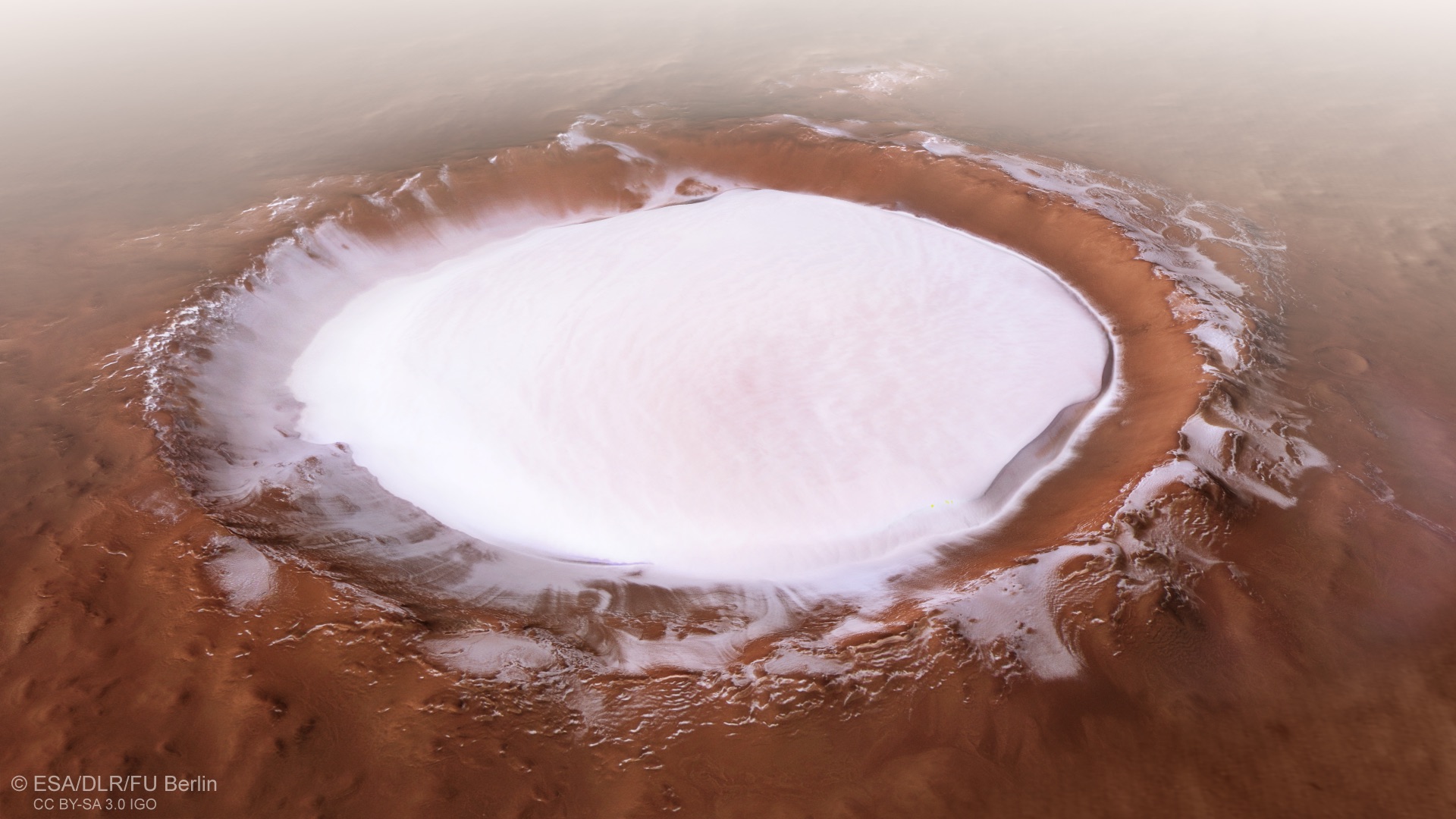 Image 1.2: Korolev crater, Mars. This 82 km diameter impact crater near the Martian north pole is permanently filled with water ice up to 1.8 km thick. The ice persists year-round because the crater floor acts as a cold trap: air flowing over the ice cools and sinks, creating a layer of cold air that insulates the ice from warmer temperatures above. ESA/DLR/FU Berlin, CC BY-SA 3.0 IGO.
The most visually striking example is Korolev crater, an 81.4 km diameter impact crater in the northern lowlands centered at 165°E, 73°N. It contains a permanent mound of water ice approximately 1.8 km thick at its center. Radar studies estimate the total ice volume at 1,400 to 3,500 km³, with 2,200 km³ being a reasonable midpoint estimate [8]. The crater functions as a natural cold trap: the thin Martian air above the ice is cooled by the ice surface, becoming denser than the surrounding atmosphere and settling into the crater, which insulates the ice from warmer air above.
The polar ice caps contain far more. The north polar cap alone holds an estimated 821,000 km³ of water ice, which is about 30% of Earth's Greenland ice sheet. If melted, it would cover the entire Martian surface to a depth of 6 meters. The south polar cap and its associated layered deposits contain approximately 1.6 million km³ total [9]. Both caps are predominantly water ice. The north cap develops a seasonal layer of carbon dioxide frost about 1 meter thick during winter, which sublimates completely each summer, revealing the water ice beneath. The south cap retains a permanent layer of carbon dioxide ice approximately 8 meters thick on its surface year-round, but the bulk of the material beneath it is water ice.
Subsurface ice has been detected by orbital radar at various latitudes, including some equatorial regions. The Mars Express MARSIS radar has found evidence of ice beneath the surface of the Medusae Fossae Formation and in other locations far from the poles [9].
The Atmosphere and ISRU
The Martian atmosphere is 95.3% carbon dioxide, with 2.7% nitrogen, 1.6% argon, and traces of other gases including water vapor. The surface pressure averages about 610 Pa, which is 0.6% of Earth's sea-level pressure [10]. This is far too thin to breathe, but it is an excellent feedstock for in-situ resource utilization (ISRU).
The Sabatier reaction converts carbon dioxide and hydrogen into methane and water:
 Equation 1.1: The Sabatier reaction combines carbon dioxide from the Martian atmosphere with hydrogen to produce methane and water, with an enthalpy change of −165.4 kJ/mol. The negative enthalpy means the reaction is exothermic: it releases energy rather than requiring it.
This exothermic character is important for ISRU because it means the reaction runs spontaneously once initiated. The methane produced is a rocket propellant (SpaceX's Raptor engines burn methane and oxygen), and the water can be electrolyzed to recover the hydrogen for recycling and produce oxygen for both breathing and as the oxidizer component of the propellant. A 2011 prototype demonstrated autonomous operation for five consecutive days, producing 1 kg/day of methane at nearly 100% conversion efficiency [11].
This is why Mars is so attractive for long-duration missions and eventual settlement. You do not have to bring all your propellant from Earth. You can make it there from the atmosphere and local water ice. The round-trip propellant mass problem, which is the single biggest cost driver for Mars missions, becomes manageable if you only have to carry propellant for the outbound trip.
Minerals and Recent Discoveries
Mars is red because its surface is coated in iron oxides, primarily nanophase Fe₂O₃ and goethite (FeO(OH)). Iron is everywhere. The regolith also contains sulfates, clay minerals (smectites), calcium sulfates (gypsum, bassanite), and a variety of other minerals that reflect a history of liquid water and chemical alteration [12].
NASA's Perseverance rover, operating in Jezero Crater since 2021, has made several significant discoveries in 2024-2025. It found mudstones containing vivianite (a hydrated iron phosphate) and greigite (an iron sulfide), along with siderite (FeCO₃) crystals. Some rocks contain over 10% siderite by weight, indicating ancient conditions where carbonates could form in liquid water [13]. The rover also detected long-chain organic compounds, including alkanes with up to 12 consecutive carbon atoms. These are not proof of life, but they are the kind of complex organic chemistry that is a prerequisite for life.
NASA's Curiosity rover, exploring Gale Crater, discovered pure elemental sulfur crystals in May 2024, which was a first for Mars [14]. China's Zhurong rover, which operated in Utopia Planitia from May 2021 until dust accumulation halted its power generation, found evidence of an ancient coastline from a short-lived ocean, along with hydrated silica and subsurface polygonal features interpreted as products of freeze-thaw cycles [15].
The Challenges
Mars is not easy. The lack of a global magnetic field means the surface is exposed to solar wind and cosmic radiation. The thin atmosphere provides minimal shielding. One meter of regolith reduces the primary particle radiation dose by about 41%, so underground or regolith-covered habitats will be necessary for long-duration stays [16].
There are localized crustal magnetic anomalies in the southern highlands, which are remnants of Mars's ancient dynamo that shut down about 4 billion years ago. These provide limited, localized radiation shielding and create interesting plasma dynamics in the upper atmosphere, but they are not a substitute for a global field [17].
Dust storms are a persistent operational hazard. They occur primarily during southern hemisphere summer and can grow to engulf the entire planet. A global dust storm killed the Opportunity rover in 2018 by coating its solar panels. Research published in 2024 identified four peak occurrence periods during the Martian year [18]. Any long-term Mars presence will need to be designed to ride out weeks-long dust events.
Then there is distance. Mars ranges from 55 million km at closest approach (opposition) to 400 million km when it is on the far side of the Sun. One-way light travel time ranges from about 4 minutes to about 24 minutes, which means round-trip communication delays of 8 to 48 minutes. Real-time remote control of surface operations is impossible. Everything on Mars must be autonomous or have humans on-site making decisions [10].
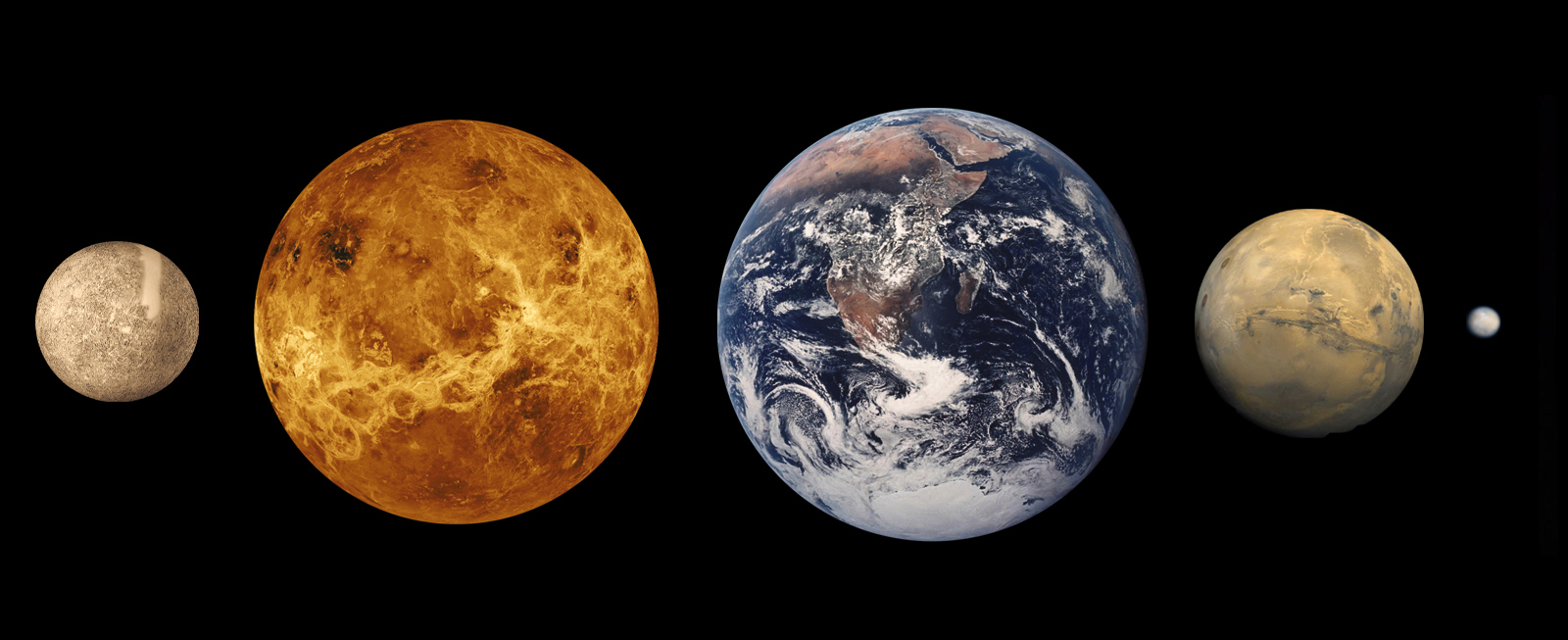 Image 1.3: The terrestrial planets to scale. Mercury, Venus, Earth, the Moon, and Mars shown at their correct relative sizes. Venus is nearly the same diameter as Earth, with 90% of Earth's surface gravity. Mars is significantly smaller, with only 38% of Earth's gravity. These size differences have profound implications for everything from atmospheric retention to escape velocity requirements. NASA, public domain.
Venus
Venus is the planet most people overlook when they talk about human expansion into the solar system, and that is a mistake. At the surface, Venus is hellish: 462°C (hot enough to melt lead), 92 bars of pressure (equivalent to being 900 meters underwater), and an atmosphere of carbon dioxide laced with sulfuric acid clouds. No spacecraft has survived on the surface for more than about two hours. But the surface is not the interesting part.
At approximately 50 km altitude, the atmosphere of Venus is the most Earth-like environment in the solar system outside of Earth itself. The temperature ranges from about 0°C to 50°C. The pressure is close to 1 bar. Gravity at the cloud deck is about 0.9g, where g refers to Earth's surface gravity of 9.81 m/s² (1.0g), compared to the Moon's 0.16g or Mars's 0.38g. The thick atmosphere above provides roughly one kilogram per square centimeter of mass shielding against cosmic radiation and solar particle events, which is comparable to Earth's atmospheric shielding and far better than what Mars offers [32]. You could stand on an open platform at this altitude and need only an oxygen mask and acid-resistant clothing, not a pressure suit.
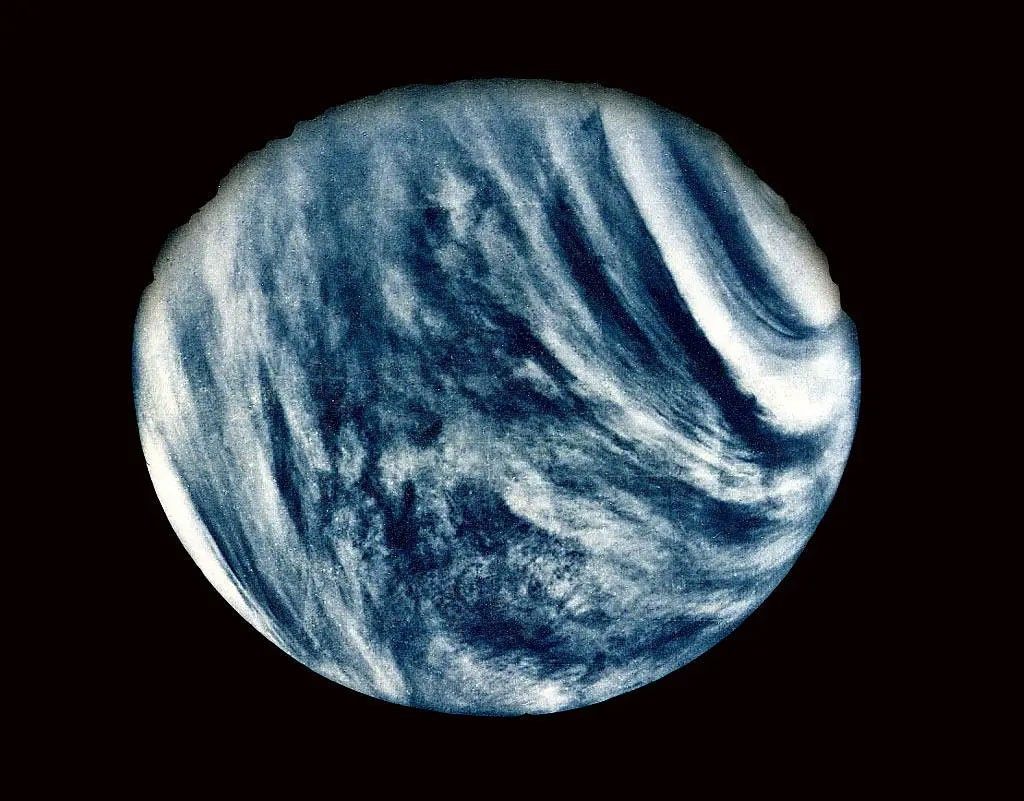 Image 1.7: Venus from Mariner 10. This image, captured by NASA's Mariner 10 spacecraft in February 1974, shows Venus's thick cloud cover in ultraviolet light. The swirling cloud patterns are composed primarily of sulfuric acid droplets and completely obscure the surface below. Beneath these clouds, at approximately 50 km altitude, lies the most Earth-like environment in the solar system outside of Earth itself. NASA/JPL, public domain.
Floating in Carbon Dioxide
Here is the engineering insight that makes Venus habitats feasible: breathable air is a lifting gas in a carbon dioxide atmosphere. A nitrogen-oxygen mix at the same temperature and pressure as the surrounding CO₂ has only about 60% of the density of that CO₂. An enclosed volume of breathing air on Venus floats the same way a helium balloon floats on Earth, with roughly 60% of the lifting force. A habitat does not need to be suspended from anything. It floats by existing.
Geoffrey Landis of NASA's Glenn Research Center worked out the engineering in detail. A large enough envelope of breathable air would lift its own structure, its equipment, and its crew [33]. The habitat does not need to be a high-pressure vessel because the internal and external pressures are nearly equal at 50 km altitude. This makes the structural requirements lightweight compared to any pressurized habitat on the Moon, Mars, or in free space. A leak is not the emergency it would be on the Moon or Mars. Air leaks in and gets filtered, rather than your atmosphere explosively decompressing into vacuum.
NASA's Langley Research Center took this further with the High Altitude Venus Operational Concept (HAVOC), a study for crewed Venus atmospheric missions using a 129-meter airship at 50 km altitude [34]. The initial mission concept supported two crew for 30 days. Longer-duration concepts envisioned permanent floating settlements.
The Nitrogen Prize
Venus's atmosphere is 96.5% carbon dioxide and 3.5% nitrogen by volume. That 3.5% sounds small, but Venus's atmosphere is about 92 times more massive than Earth's. The total mass of nitrogen in Venus's atmosphere is roughly four times the total mass of nitrogen in Earth's atmosphere [35]. Venus is, by a wide margin, the largest accessible reservoir of nitrogen in the inner solar system.
This matters enormously for the CHNOPS problem discussed later in this chapter. Nitrogen is one of the two elements (along with hydrogen) that are scarce at most destinations beyond Earth. The Moon has essentially none. Mars has 2.7% nitrogen in an atmosphere that is already paper-thin, which amounts to very little in absolute terms. But Venus has more nitrogen than Earth does, and it is floating in the atmosphere, available for collection without mining, drilling, or processing rock.
For any future civilization that needs nitrogen for agriculture, biological life support, or industrial chemistry, Venus is the place to get it. Extracting nitrogen from Venus's atmosphere is a gas separation problem using well-understood methods, not fundamentally different from the air separation plants that operate on Earth today.
Closer Than Mars
Venus is also closer to Earth than Mars is. At closest approach, Venus comes within about 38 million km, compared to Mars's 55 million km. Transit times with reasonable delta-v budgets are shorter than for Mars. The near-Earth-level gravity at the cloud deck means that astronauts living in Venus floating habitats would not face the bone and muscle loss problems associated with long stays on Mars (0.38g) or the Moon (0.16g).
The sulfuric acid clouds concentrated between about 45 and 70 km altitude are a real engineering challenge, but sulfuric acid is a well-understood industrial chemical. Acid-resistant materials exist and are used routinely in chemical processing plants on Earth. The acid clouds are also a potential resource: sulfuric acid can be decomposed into sulfur, oxygen, and water, all of which are useful.
Venus deserves to be part of the conversation about human expansion into the solar system. It is not the barren hellscape that casual descriptions suggest. At the right altitude, it offers better living conditions than Mars in several respects: near-Earth gravity, better radiation shielding, a simpler structural engineering problem, and the largest nitrogen supply in the inner solar system. The fact that it has been largely ignored in favor of Mars says more about our fixation on solid ground than it does about the engineering tradeoffs.
The full case for Venus, including its atmospheric ISRU potential, the three-dimensional carrying capacity of its habitable zone, the role of aircraft and airships, the problem of escaping its gravity well, and how a Venusian orbital ring changes everything, is developed in Chapter 17.
Asteroids
Between Mars and Jupiter lies the main asteroid belt, and scattered throughout the inner solar system are the near-Earth asteroids (NEAs). As of mid-2025, we have discovered approximately 900 NEAs larger than 1 km, about 11,400 of the estimated 24,000 NEAs larger than 140 meters, and over 40,000 objects larger than 10 meters [19]. These numbers grow every month as survey telescopes improve, and they will increase dramatically when the Vera C. Rubin Observatory begins full operations.
What Asteroids Are Made Of
Asteroids come in three broad compositional classes. C-type (carbonaceous) asteroids make up about 75% of the known population. They are dark, composed of carbon, clay, silicate minerals, and in many cases contain water bound in hydrated minerals and organic compounds. S-type (siliceous) asteroids are brighter, made of silicate minerals and nickel-iron, and dominate the inner asteroid belt. M-type (metallic) asteroids are composed primarily of nickel and iron and are thought to be the exposed cores of ancient planetesimals whose rocky mantles were stripped away by collisions [20].
We now have direct laboratory analysis of asteroid material from two sample return missions. NASA's OSIRIS-REx mission returned 121.6 grams of material from asteroid Bennu in September 2023. Bennu is a carbonaceous asteroid, and the samples were rich in carbon, nitrogen, and organic compounds, dominated by clay minerals (particularly serpentine), and contained magnesium-sodium phosphate, which was not expected and suggests Bennu may have originated from a small body that once had a liquid water ocean [21]. The samples also contained sugars essential for biology, amino acids, nucleobases, and abundant presolar dust grains from ancient supernovae.
Japan's Hayabusa2 mission returned 5.4 grams from asteroid Ryugu in December 2020. Ryugu turned out to be a CI chondrite, which is a rare type of carbonaceous meteorite whose bulk composition closely matches that of the Sun (minus the volatile gases). The samples contained thousands of different organic molecules, including amino acids and aromatic hydrocarbons, and showed evidence of aqueous alteration from liquid water in the parent body about 5 million years after the solar system formed [22]. The Ryugu material has an extremely low density of about 1,282 kg/m³ and represents the most primitive natural sample available to science, essentially unaltered building blocks from the formation of the solar system.
Accessibility
Here is something that surprises most people: some near-Earth asteroids are easier to reach than the Moon. The Moon requires about 5.7 km/s of delta-v (velocity change) from low Earth orbit for a one-way trip. Many NEAs require only about 3.8 km/s outbound, and with the use of Earth atmospheric aerobraking on return, the return delta-v can be as low as 60 m/s [23]. Roughly 10% of known NEAs are more accessible than the Moon for round-trip missions, and at least half of those are likely to be useful orebodies.
The catch is timing. Because NEA orbits are elliptical and inclined relative to Earth's orbit, efficient transfer windows come and go. For some asteroids, the interval between favorable launch windows can be years or decades. A database maintained by NASA's Center for Near Earth Object Studies lists over 6,300 accessible NEA missions with durations under six years in the 2030-2065 timeframe [23]. That is a large catalog of potential targets, but exploiting it requires the ability to launch frequently and cheaply, which brings us back to the need for space infrastructure.
16 Psyche
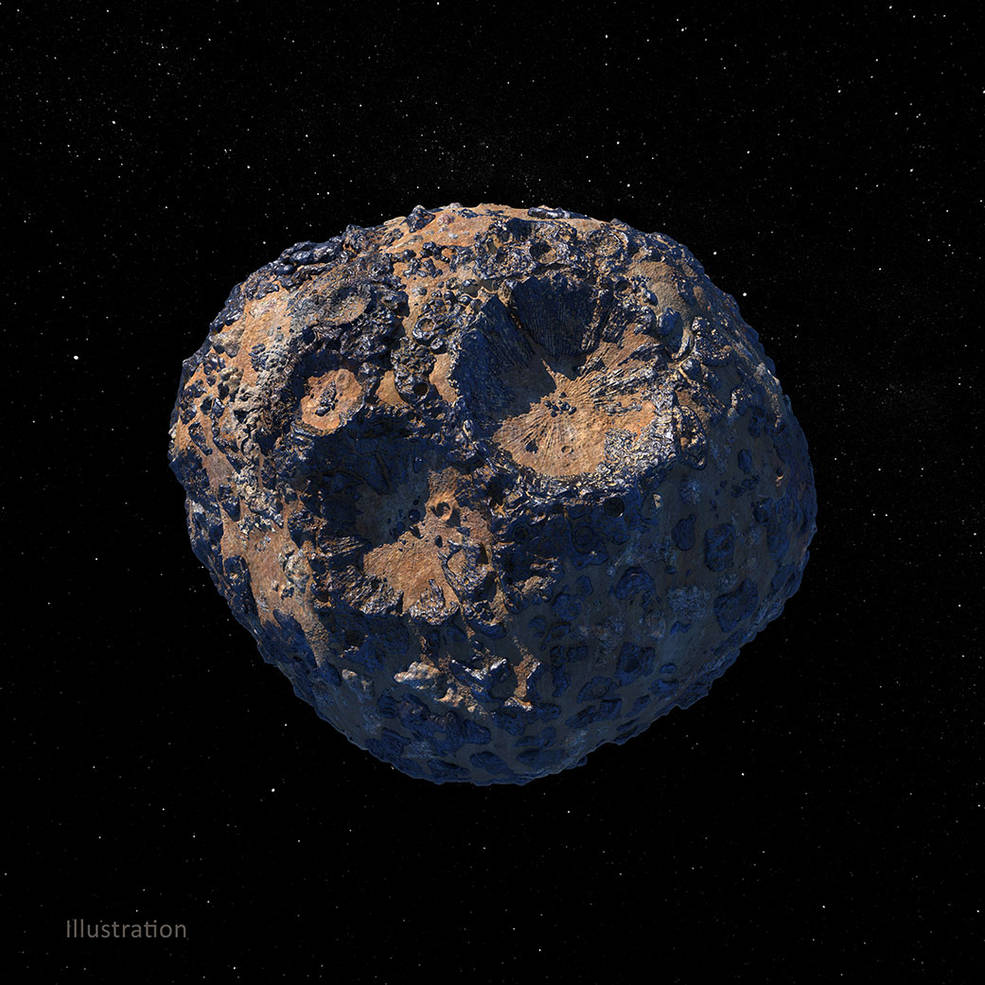 Image 1.4: NASA's Psyche spacecraft and its target asteroid. The Psyche mission, launched in October 2023, will arrive at the metallic asteroid 16 Psyche in late July 2029. If the asteroid is what it appears to be, it contains more nickel-iron than humanity has ever mined. NASA/JPL-Caltech/ASU, public domain.
One asteroid deserves special mention. 16 Psyche is an M-type asteroid roughly 220 km across, orbiting in the main belt between Mars and Jupiter. It was originally thought to be up to 95% nickel-iron, which would make it the exposed metallic core of a destroyed protoplanet. More recent analysis suggests a more complex composition of 30-60% metal by volume, mixed with rock [24]. NASA's Psyche spacecraft, launched in October 2023, will arrive in late July 2029 and begin its science mission in August 2029. If Psyche turns out to be what it appears to be, it would represent a quantity of refined metal that dwarfs everything humanity has ever mined.
We are not going to mine Psyche any time soon. It is in the main belt, far from Earth, and the delta-v requirements are substantial. But its existence illustrates a point: the solar system contains resources on a scale that makes terrestrial mining look like scratching in the dirt.
The Building Blocks of Life and Industry
Before moving to the outer solar system, it is useful to take stock of where the essential elements stand. Life and industrial chemistry both depend on six key elements: carbon, hydrogen, nitrogen, oxygen, phosphorus, and sulfur (CHNOPS). Any self-sustaining presence in space needs reliable access to all six.
Oxygen is the easiest. It is abundant on the Moon (41-45% of regolith by weight), on Mars (bound in CO₂, metal oxides, and water), and in asteroid minerals. Oxygen supply is an engineering problem, not a scarcity problem.
Carbon is available in Mars's CO₂ atmosphere (95.3%), in virtually unlimited quantities from Venus's CO₂ atmosphere (96.5% of an atmosphere 92 times more massive than Earth's), in carbonaceous (C-type) asteroids (which make up 75% of the asteroid population), and in trace amounts on the Moon from solar wind implantation and meteorite delivery.
Sulfur has been found on the Moon (Chandrayaan-3), on Mars (Curiosity found pure elemental sulfur crystals), in meteoritic material, and in Venus's sulfuric acid cloud layer between 45 and 70 km altitude.
Phosphorus is essential for DNA, RNA, ATP, and cell membranes, which makes it non-negotiable for any biological system. It has been detected in asteroid Bennu samples returned by OSIRIS-REx, where it appeared as magnesium-sodium phosphate in concentrations that were not expected and suggest Bennu's parent body once had liquid water. Phosphorus was also confirmed in the plume material ejected from Enceladus's subsurface ocean by the Cassini spacecraft, making Enceladus the first place beyond Earth where all six CHNOPS elements have been detected in a single environment [27]. On Mars, the Perseverance rover found vivianite (a hydrated iron phosphate) in Jezero Crater mudstones [13]. Lunar regolith contains phosphorus in apatite minerals at low concentrations. The element is present at multiple destinations, but nowhere in the concentrated ore deposits that Earth's biology depends on. Phosphorus logistics will need careful attention in any self-sustaining off-world settlement.
Hydrogen is the critical constraint close to Earth. Despite being the most abundant element in the universe, its volatility means it escapes from low-gravity, airless bodies. On the Moon, the primary hydrogen source is water ice in permanently shadowed craters. On Mars, it is available in water ice and can be extracted from atmospheric water vapor. On Venus, the sulfuric acid cloud layer can be decomposed into sulfur, oxygen, and water, providing a hydrogen source at the cloud deck altitude. In asteroids, hydrated minerals in C-type bodies contain substantial hydrogen. Farther out, the icy moons of Jupiter and Saturn are essentially unlimited reservoirs of water and therefore hydrogen. But in the inner solar system, hydrogen availability is the bottleneck that determines how fast you can scale.
Nitrogen is the other difficult one. It is abundant in only three places in the solar system: Earth's atmosphere (78%), Venus's atmosphere (3.5% by volume, but roughly four times Earth's total nitrogen mass due to Venus's much denser atmosphere), and Titan's atmosphere (95%). Mars has 2.7% nitrogen in its thin atmosphere, which amounts to very little in absolute terms. The Moon has only trace amounts from solar wind implantation. Asteroids contain some nitrogen in organic compounds, but it is not concentrated. Venus's role here is underappreciated: as described earlier in this chapter, it is the largest accessible nitrogen reservoir in the inner solar system, and the nitrogen is in the atmosphere where it can be collected by gas separation rather than mined from rock. For any large-scale biological system beyond Earth (agriculture, closed-loop life support), nitrogen supply will be a logistics challenge, but Venus offers a solution that is closer and more abundant than Titan.
The bottom line: oxygen, carbon, and sulfur are widely available. Phosphorus has been confirmed at multiple destinations, including asteroid Bennu, Mars's Jezero Crater, Enceladus's ocean, and in lunar apatite minerals, but nowhere in the concentrated deposits that would make extraction easy. Hydrogen is available but concentrated in specific deposits (Venus sulfuric acid, lunar PSR ice, Mars polar caps, asteroid hydrates, outer solar system ice). Nitrogen is scarce at most destinations but abundantly available on Venus and Titan. These constraints shape where you can build, what you can build, and what supply chains you need to maintain.
The Outer Solar System
Beyond the asteroid belt, the giant planets and their moons offer something different from inner solar system resources: scientific discoveries that could redefine our understanding of life itself, along with effectively unlimited reserves of the very elements (water, nitrogen, hydrogen) that are scarce closer to home.
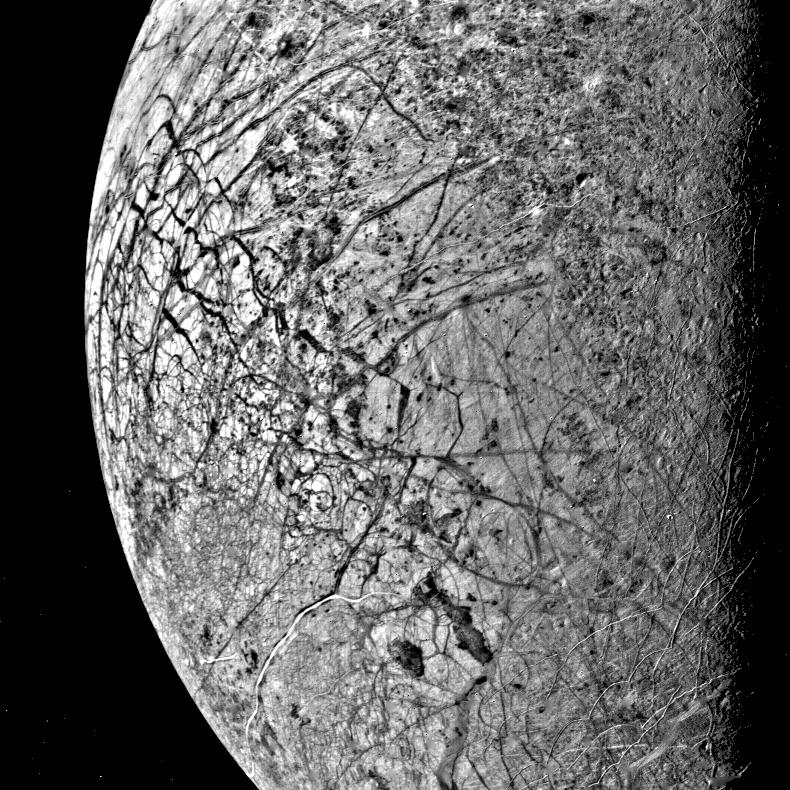 Image 1.8: Europa's fractured ice surface. This global view from NASA's Galileo spacecraft shows the network of cracks and ridges that cover Europa's ice shell. The brown-red lineae are thought to be material from the subsurface ocean that has welled up through fractures and frozen. Beneath this ice shell, which is roughly 29 km thick, lies a saltwater ocean that may contain more water than all of Earth's oceans combined. NASA/JPL-Caltech, public domain.
Europa
Europa is one of Jupiter's four large Galilean moons, with a diameter of about 3,122 km (slightly smaller than Earth's Moon). Its surface is a shell of water ice, and beneath that ice lies a saltwater ocean. This is not speculation. The ocean was inferred from magnetic field measurements by the Galileo spacecraft and confirmed by multiple lines of evidence since.
NASA's Juno spacecraft measured Europa's ice shell thickness during a 2022 flyby using its Microwave Radiometer: 29 ± 10 km [25]. Beneath that shell, the ocean extends to considerable depth, likely in contact with a rocky seafloor. The ocean's salinity is estimated at 0.5-2.0% by weight, with sodium chloride, sodium bicarbonate, and potassium chloride as the primary dissolved salts [26].
Europa matters because liquid water in contact with a rocky seafloor, with an energy source (tidal heating from Jupiter's gravity), is the recipe for hydrothermal vents, which is one of the leading hypotheses for where life originated on Earth. Whether anything lives in Europa's ocean is one of the biggest open questions in science. NASA's Europa Clipper mission, launched in October 2024, will perform dozens of close flybys to study the ice shell, ocean, and geology in detail.
Enceladus
Saturn's moon Enceladus is small (only 504 km in diameter) but extraordinary. The Cassini spacecraft discovered that Enceladus actively vents water into space through fractures near its south pole, ejecting approximately 200 kg/s of water vapor, molecular hydrogen, and other materials [26]. Analysis of this plume material revealed sodium chloride crystals, organic compounds, molecular nitrogen, carbon dioxide, methane, propane, acetylene, and formaldehyde.
In 2023, researchers confirmed the presence of phosphates in the plume material [27]. This was significant because phosphorus is one of the six elements essential for life as we know it (carbon, hydrogen, nitrogen, oxygen, phosphorus, and sulfur, collectively CHNOPS), and Enceladus became the first place beyond Earth where all six have been detected in a single environment.
The ocean beneath Enceladus is global, approximately 26-31 km deep, and the entire icy crust is detached from the rocky core [26]. Evidence suggests hydrothermal activity on the ocean floor, where hot water dissolves silica and minerals that are carried upward through the water column and out through the south polar fractures.
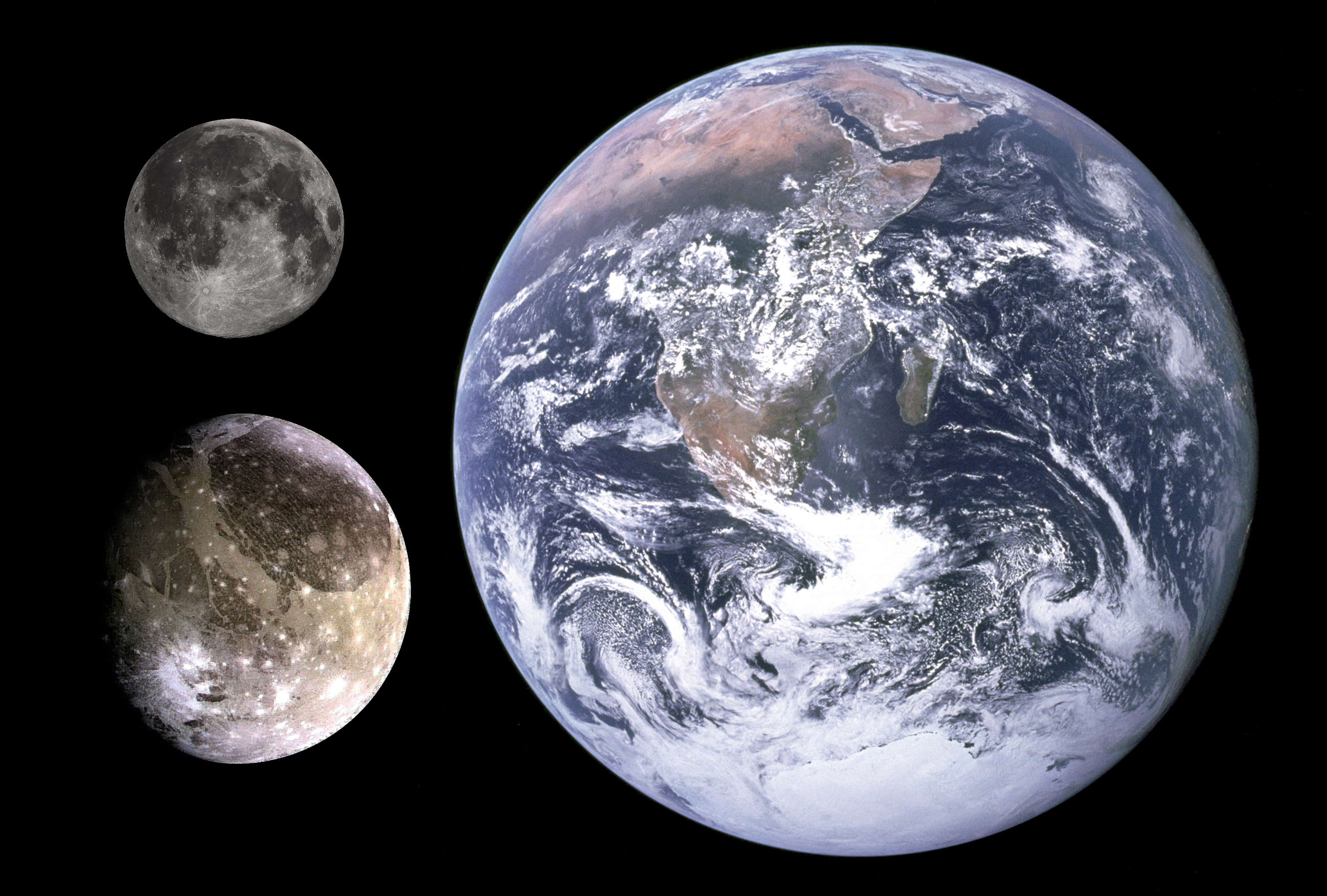 Image 1.5: Ganymede, Earth, and the Moon to scale. Ganymede, the largest moon in the solar system, is bigger than the planet Mercury. It has its own magnetic field, a subsurface ocean, and a differentiated interior with a metallic core. Understanding the scale of these worlds is essential to appreciating the scope of resources available in the outer solar system. NASA, public domain.
Ganymede
Ganymede is the largest moon in the solar system, with a diameter of approximately 5,260 km, which makes it larger than the planet Mercury. It is the only moon known to generate its own magnetic field. Hubble Space Telescope observations of Ganymede's aurorae in 2015 confirmed the existence of a subsurface ocean, estimated to be about 100 km thick, which is roughly ten times deeper than Earth's oceans. This ocean is buried beneath an ice crust about 150 km thick [28].
ESA's JUICE spacecraft, launched in April 2023, will arrive at Jupiter in July 2031 and eventually enter orbit around Ganymede in December 2034, making it the first spacecraft to orbit a moon other than our own. JUICE will measure Ganymede's magnetic field, characterize its ice shell and ocean, and assess its habitability. If Ganymede's ocean turns out to be as large as estimated, it would contain more water than all of Earth's oceans combined.
Callisto
Callisto, another of Jupiter's Galilean moons (diameter ~4,821 km), was long considered the least interesting of the four because its surface is ancient and heavily cratered, suggesting little geological activity. But evidence from the Galileo mission and more recent analysis published in 2025 now suggests that Callisto is "very likely an ocean world" [29]. The ocean may lie 80-150 km beneath a cold, stiff ice lithosphere and could be tens of kilometers thick, potentially extending to 250-300 km depth if antifreeze compounds (dissolved salts or organic molecules) lower the freezing point.
Callisto's relative geological quiescence is actually an advantage for some purposes. Its surface is less radiation-bombarded than Europa's (because it orbits farther from Jupiter and outside the most intense radiation belts), making it a more practical location for a crewed outpost than Europa would be.
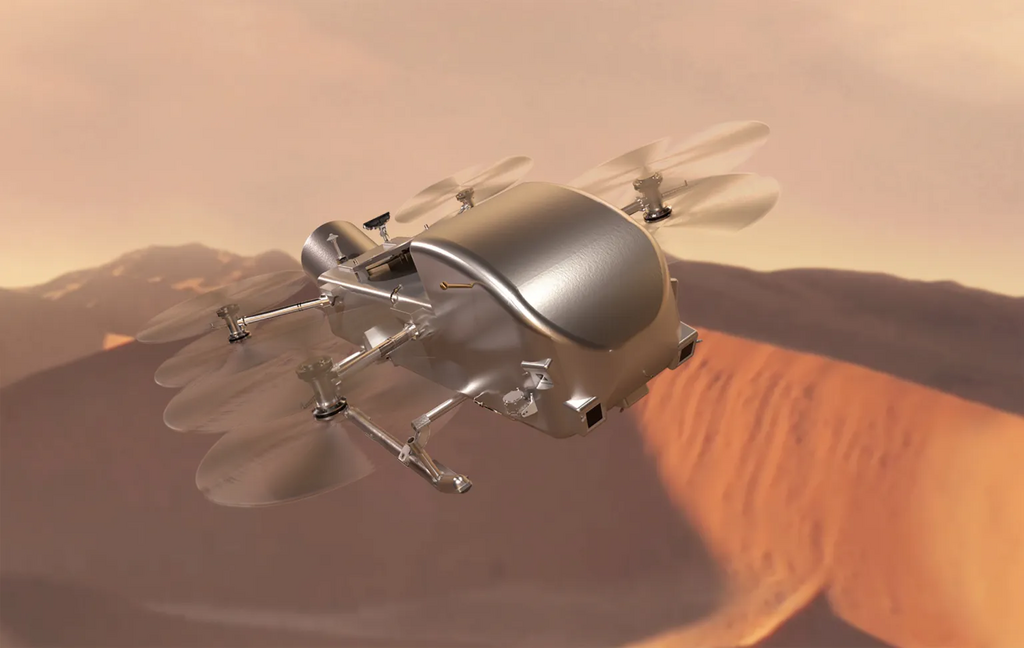 Image 1.6: NASA's Dragonfly mission to Titan. Dragonfly is a nuclear-powered rotorcraft scheduled for launch in July 2028, arriving at Titan in the mid-2030s. It will fly from site to site across Titan's surface, sampling the organic-rich terrain. Titan's thick nitrogen atmosphere, which is 1.5 times denser than Earth's, makes powered flight relatively easy. NASA/Johns Hopkins APL, public domain.
Titan
Saturn's largest moon Titan (diameter ~5,150 km, nearly as large as Ganymede) is unique in the solar system. It has a thick atmosphere, denser than Earth's, with a surface pressure of about 1.5 bars (1.48 times Earth's atmospheric pressure). The atmosphere is 95% nitrogen with 5% methane and traces of other carbon-rich compounds [30].
Titan is the only body in the solar system besides Earth known to have stable liquid on its surface. The liquid is not water but methane and ethane, which form lakes and seas in the polar regions. Beneath the surface, Titan also has a layer of liquid water.
What makes Titan scientifically compelling is its organic chemistry. Ultraviolet sunlight and energetic particles from Saturn's magnetosphere break apart methane and nitrogen molecules in the upper atmosphere, producing hydrocarbons and nitrogen-bearing organics that polymerize into solid aerosol particles called tholins. These settle to the surface, coating everything in a layer of complex organic material. Titan is essentially running a planetary-scale prebiotic chemistry experiment, producing the kinds of molecules that are thought to be precursors to life.
NASA's Dragonfly mission, a rotorcraft lander scheduled for launch in July 2028, will arrive at Titan in the mid-2030s and fly from site to site across the surface, sampling the organic-rich terrain and investigating how far prebiotic chemistry has advanced [30].
What an Orbital Ring Changes
Everything described in this chapter is real. The water ice on the Moon is real. The resources on Mars are real. The subsurface oceans on Europa and Enceladus are real. The organic chemistry on Titan is real. The metals in asteroids are real. The science that could be done at these destinations is transformative.
What is also real is that we currently have no way to exploit any of it at meaningful scale. We can send a rover to Mars every couple of years. We can land a small probe on the Moon every few months if funding holds. We can launch a flyby mission to the outer solar system once a decade. These are remarkable achievements, but they are fundamentally limited by the economics of chemical rocketry. Every kilogram that leaves Earth's surface costs thousands of dollars and requires propellant that is itself a significant fraction of the total vehicle mass.
An orbital ring changes this equation entirely. A mass driver on an orbital ring can launch cargo at up to 30 km/s with no propellant expenditure. Combined with Earth's orbital velocity of roughly 30 km/s, this gives a total velocity of approximately 60 km/s for objects launched during favorable alignment windows. For comparison, the Voyager spacecraft are traveling at about 17 km/s. A mass-driver-launched cargo vessel at 60 km/s could reach Mars in weeks rather than months, Jupiter in months rather than years, and could sustain annual resupply missions to deep space destinations.
The orbital ring would also support millions of passengers per day traveling to and from orbit, create a platform for terawatts of solar power generation, and provide the launch infrastructure needed for planetary defense at a scale that is currently impossible. We will explore all of these capabilities in detail in later chapters.
But the first point to establish is the simplest one: the solar system is worth reaching. The resources are there. The science is there. The destinations are there. What is missing is the transportation system.
The rest of this book is about building it.
End of excerpt. Volume I continues with Chapters 2 through 20, covering the science that drives us, what we cannot see, what could hit us, the first space age, the politics, the launch technologies that came before, and the case for the orbital ring itself.