Paul G. de Jong
Paul G. de Jong is the author of Orbital Ring Engineering and the Astronomy's Shocking Twist series: five engineering textbooks and five hard science fiction novels about mass transit to space.
Everything on this page may be used as is for articles, reviews, podcast notes and event programs. The bios, headshots and cover files are current; the book data below matches the Publication details on each book's page and the listings in the stores.
Interviews, review copies and permissions: [email protected]. Rights and bulk orders: [email protected].
Bios
Four lengths, all in the third person. Use any of them as written; a shortened version is fine as long as the name and the book titles stay intact.
One line 31 words
Paul G. de Jong is the author of Orbital Ring Engineering and the Astronomy's Shocking Twist series: five engineering textbooks and five hard science fiction novels about mass transit to space.
Short 73 words
Paul G. de Jong writes at the intersection of physics, electronics and engineering, with three decades of work in medical ultrasound, hydrogen energy, software, audio and a home physics lab. Orbital Ring Engineering is his three-volume engineering treatment of space mass transit infrastructure: orbital rings, mass drivers and space elevators. His threshold for suspension of disbelief is very low, and the technical series arose from a desire for more truly hard science fiction.
Medium 185 words
Paul G. de Jong is the author of Orbital Ring Engineering, a three-volume engineering treatment of orbital rings, mass drivers and space elevators, and of Why Space, the economic case for mass transit to space written for the general reader. Both belong to Astronomy's Shocking Twist, a ten-book project: five technical books written to serve as undergraduate textbooks and five hard science fiction novels set in the world the technical books describe. The novels obey the known laws of physics. People live normal lifespans, propulsion is limited by the power that can be produced, materials are limited to reasonable extrapolations of current research, heat has to go somewhere, and every trajectory is calculated with real orbital mechanics.
De Jong studied electronics and physics at Heald Institute of Technology, Ohlone College, UC Berkeley and the University of Amsterdam. He has worked as an electronics technician in medical ultrasound, in hydrogen energy when it was still a fringe topic, and as an inventor and software entrepreneur in San Francisco. His derivations are done in MathCAD and checked against open-source Python simulations that readers can download and run.
Long 410 words
Paul G. de Jong is the author of Orbital Ring Engineering, a three-volume engineering treatment of space mass transit infrastructure, and of Why Space, the economic case for building it. The books belong to Astronomy's Shocking Twist, a ten-book project in two tracks. The technical track is five non-fiction books on orbital rings, mass drivers, space elevators, ion propulsion, generational ships and large-scale space habitation, written to serve as undergraduate textbooks. The fiction track is five hard science fiction novels that share one universe and use the technology the textbooks describe. The two tracks are meant to reinforce each other: the fiction tells a story that could happen, and the technical books show how it could be done with real materials and real numbers.
De Jong has been thinking about orbital rings and space infrastructure for more than ten years. The series is the long version of that thought. Much of it was prompted by Isaac Arthur's YouTube channel, Science and Futurism with Isaac Arthur, whose episodes on orbital rings and megastructures he still recommends as the best accessible introduction to the subject.
His career has crossed several fields: electronics technician at Acuson Medical Ultrasound in the late 1980s, member of the Hydrogen Energy Society in the 1990s when hydrogen was a fringe topic, and a project called Making Math Fun in the same decade when he was considering teaching. Since then he has worked in software and audio as an inventor and serial entrepreneur, founding AnyTaxi, Club Clock and KaraokeListMaker in San Francisco, while keeping a home physics lab active throughout. He studied electronics at Heald Institute of Technology and physics at Ohlone College, UC Berkeley and the University of Amsterdam. The common thread across ultrasound, hydrogen, software, audio, the lab and space infrastructure is a habit of showing the work.
That habit shapes how the books are written. Derivations are performed in MathCAD and verified against simulation code written in Python. The simulation code is open source on GitHub. Every major number in the books comes from one of three sources: a peer-reviewed publication, a calculation presented in the book, or a simulation whose code the reader can download and run. De Jong uses AI tools for research, technical verification and editorial feedback; the engineering decisions, design choices and writing are his own, and so are any errors. The Errata page on this site is where readers report them.
He is Dutch-American and writes under his own name.
Headshots
Click an image for the full-size file. Credit as noted. No alteration beyond cropping, please.

600 × 600 px
Download
Cover art
Full-resolution covers for articles, reviews and presentations. Click a cover for the file.

800 × 1200 px
Pre-order · Download
800 × 1200 px
Published · Download
Book data
The same details are on each book's page under Publication details.
Orbital Ring Engineering, Volume I: Space Mass Transit Complete Design Review
- Author
- Paul G. de Jong
- Series
- Astronomy's Shocking Twist, technical works; Orbital Ring Engineering, Volume I of 3
- Publisher
- Paul G. de Jong
- Publication date
- December 2026
- Status
- Pre-order
- Language
- English
- Pages
- 450
- Chapters
- 19
- Formats
- Hardcover, Paperback, Kindle
- ISBN-13, hardcover
- 979-8-9932868-6-0
- ISBN-13, paperback
- 979-8-9932868-7-7
- ISBN-13, e-book
- 979-8-9932868-8-4
- Library of Congress Control Number
- 2026929155
- Subjects
- Technology & Engineering / Aeronautics & Astronautics; Science / Space Science / General; Technology & Engineering / Engineering (General)
- BISAC codes
- TEC002000
- Audience
- Undergraduate engineering and physics students; engineers and technically literate general readers
- List price, hardcover
- US$ 59.95
- List price, paperback
- US$ 44.95
Volume I is the complete design review, and the volume to read first. It takes the ring as a whole, at one altitude, with one cable, one bearing, one set of motors and one power system, and asks whether it all works together. The answer is mostly yes, with the caveats stated, and the open questions are listed for the team that eventually builds the ring. Volumes II and III carry the derivations behind the numbers: the first principles and the launch technologies.
Why Space: Apollo, the Lost Decades, the New Space Race, and the Infrastructure Worth Building
- Author
- Paul G. de Jong
- Publisher
- Paul G. de Jong
- Status
- Forthcoming
- Language
- English
- Chapters
- 20
- Formats
- Hardcover, Paperback, Kindle
- ISBN-13, hardcover
- 979-8-9932868-3-9
- ISBN-13, paperback
- 979-8-9932868-4-6
- ISBN-13, e-book
- 979-8-9932868-5-3
- Subjects
- Science / Space Science / General; Political Science / Public Policy / Science & Technology Policy; History / Modern / 20th Century
- Audience
- General readers; no engineering background needed
The economic case for space mass transit, written for the general reader. The standalone companion to Orbital Ring Engineering.
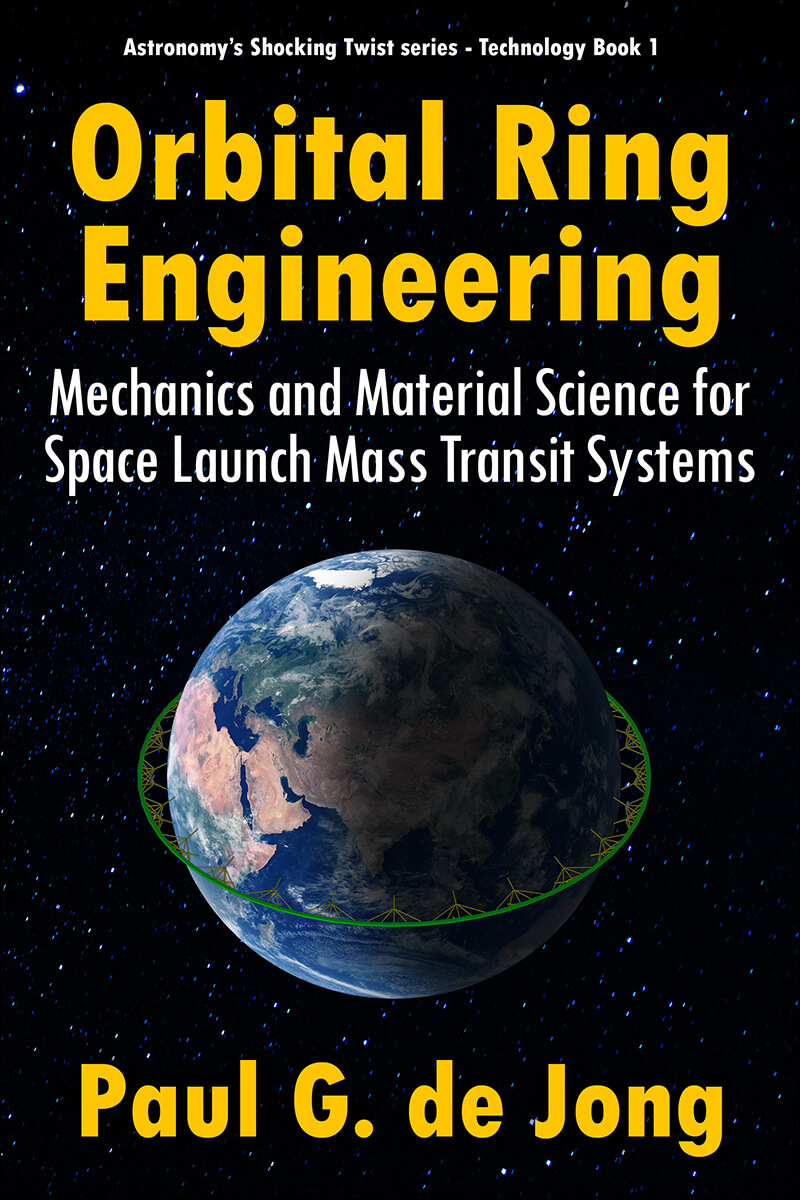
Orbital Ring Engineering: Mechanics and Material Science for Space Launch Mass Transit Systems
- Author
- Paul G. de Jong
- Series
- First edition, replaced by Orbital Ring Engineering in three volumes
- Publisher
- Paul G. de Jong
- Publication date
- 16 October 2025
- Language
- English
- Formats
- Hardcover, Paperback, Kindle
- ISBN-13, paperback
- 979-8-9932868-0-8
- Amazon ASIN, hardcover
- B0FWYN8VLB
- Amazon ASIN, paperback
- B0FWYNHQZY
- Amazon ASIN, kindle
- B0FWYMJTPG
- Subjects
- Technology & Engineering / Aeronautics & Astronautics; Science / Space Science / General; Technology & Engineering / Engineering (General)
- BISAC codes
- TEC002000
- Audience
- Undergraduate engineering and physics students; engineers and technically literate general readers
The original single-volume edition of 2025. The three volumes of Orbital Ring Engineering replace and expand it; Volume I is the one to read first.
Talking points
Subjects Paul can speak to on a podcast, a panel or in an interview.
- What an orbital ring is, in one minute: a cable in orbit moving faster than orbital velocity, a stationary casing riding on it, anchor lines tying it to the ground, and a mass driver on top that throws spacecraft to the Moon and Mars. No rockets, no fuel, no countdown.
- Why mass transit to space is an engineering question, not a physics question: every part of the ring uses known physics and materials that exist or are reasonable extrapolations of current research.
- The heat problem: heat dissipation, not thrust, is the limit on space propulsion and on any megastructure, and what that does to the design.
- The power budget: how much power an orbital ring needs, where it comes from, and why the same ring can power the planet.
- Hard science fiction in the strictest sense: known laws, real materials, normal lifespans, real orbital mechanics, and why the fiction gets better when the author is not allowed to cheat.
- Writing a textbook and a novel series at the same time, and how each one changes the other.
- Showing the work: every number traceable to a paper, a calculation in the book, or open-source code the reader can run.
- Using AI tools in technical writing without letting them do the engineering.
- From Isaac Arthur's YouTube channel to a ten-book series: how a hobby of thinking about megastructures became a full-time project.
- Why the 2025 first edition of Orbital Ring Engineering was replaced by three volumes, and what a complete design review of an orbital ring looks like.
At a glance
- Series
- Astronomy's Shocking Twist (AST), ten books in two tracks
- Technical track
- Five books written to serve as undergraduate textbooks
- Fiction track
- Five hard science fiction novels over eight hundred years, in one universe
- First book
- Orbital Ring Engineering, 1st edition, October 2025
- Current release
- Orbital Ring Engineering, Volume I: Space Mass Transit Complete Design Review, December 2026
- Open source
- Simulation code at github.com/kjpaul/orbitalring
- Publisher
- Paul G. de Jong, ISBN prefix 979-8-9932868
- Name
- Paul G. de Jong (sort as de Jong, Paul G.)
- Website
- pauldejong.com
Author mark

Links
- Amazon author https://www.amazon.com/stores/Paul-G.-de-Jong/author/B0FWZ55SKP
- Github https://github.com/kjpaul
- Github project https://github.com/kjpaul/orbitalring
- Patreon https://www.patreon.com/kjpaul/
- Linkedin https://www.linkedin.com/in/paul-g-de-jong/
- Project site https://orbitalring.space
- Errata https://pauldejong.com/errata/
- Reviews https://pauldejong.com/review/